Fintech Seed Capital 2026: Strategies for US Startups

Raising Fintech Seed Capital in 2026: 5 Key Strategies for US Startups
The landscape of financial technology (fintech) is in a perpetual state of evolution, marked by rapid innovation, shifting consumer demands, and an increasingly sophisticated regulatory environment. For US fintech startups, securing first-round funding, often referred to as seed capital, is a critical milestone that can dictate the trajectory of their journey. As we look ahead to 2026, the strategies for attracting and securing this vital capital are becoming more nuanced, demanding a proactive and well-informed approach from aspiring entrepreneurs.
The global fintech market size was valued at USD 266.0 billion in 2021 and is projected to reach USD 1,691.0 billion by 2030, growing at a CAGR of 22.1% from 2022 to 2030. This exponential growth underscores the immense potential within the sector, but also highlights the intense competition for investor attention. In this dynamic environment, a compelling idea alone is often not enough. Startups must demonstrate a clear path to market, a robust business model, and a team capable of executing their vision.
Understanding the mindset of investors in 2026 is paramount. They are not merely looking for innovative technology; they seek solutions addressing real-world problems, with scalable models and defensible competitive advantages. Moreover, the emphasis on ESG (Environmental, Social, and Governance) factors, data privacy, and regulatory compliance will continue to grow, influencing investment decisions more profoundly than ever before. This comprehensive guide will delve into five pivotal strategies that US fintech startups can leverage to successfully secure fintech seed capital in 2026, positioning themselves for sustainable growth and impact.
1. Validate Your Problem-Solution Fit and Market Opportunity
Before even thinking about approaching investors for seed capital, a fintech startup must meticulously validate its problem-solution fit and the overall market opportunity. Investors in 2026 will be more discerning than ever, seeking concrete evidence that your product or service addresses a significant, unmet need within a substantial and accessible market. This isn’t just about having a great idea; it’s about proving that your idea resonates with a target audience and has the potential for widespread adoption.
Deep Dive into Market Research: Start with exhaustive market research. Identify your target demographic, understand their pain points, and analyze existing solutions. What are the gaps in the current market? How does your proposed fintech solution uniquely address these gaps? Quantitative data, such as market size, growth projections, and competitive analysis, is crucial. However, don’t overlook qualitative insights gained from surveys, interviews, and focus groups with potential customers. This human-centric data provides invaluable validation and helps refine your product offering.
Proof of Concept and Early Traction: A compelling proof of concept (PoC) or a minimum viable product (MVP) is indispensable. A PoC demonstrates the feasibility of your technology, while an MVP allows you to gather early user feedback and demonstrate traction. Even if it’s a small pilot program, showing early adoption, positive user engagement, or even a waiting list of interested customers can significantly bolster your case for fintech seed capital. Metrics like customer acquisition cost (CAC), customer lifetime value (CLTV), and user retention rates, even if nascent, provide tangible evidence of your startup’s potential.
Definitive Value Proposition: Clearly articulate your unique value proposition. What makes your fintech solution stand out from the competition? Is it superior technology, a disruptive business model, enhanced user experience, or a unique regulatory approach? Investors want to understand the defensibility of your innovation and how you plan to maintain a competitive edge as the market evolves. Highlighting intellectual property (IP), proprietary algorithms, or unique data sets can further strengthen your position.
Regulatory Acumen: For fintech, regulatory compliance is not an afterthought; it’s a foundational element. Investors will scrutinize your understanding of the regulatory landscape (e.g., SEC, FinCEN, state-specific regulations) and your strategy for navigating it. Demonstrating a proactive approach to compliance, perhaps by engaging with legal counsel or advisors specializing in fintech regulations, will instill confidence. A clear understanding of licensing requirements, data privacy laws (like CCPA), and anti-money laundering (AML) protocols is essential.
2. Craft a Robust and Scalable Business Model with Clear Revenue Streams
A brilliant idea without a viable business model is often just that – an idea. To attract fintech seed capital in 2026, US startups must present a clear, robust, and scalable business model that explicitly outlines how they will generate revenue and achieve profitability. Investors are looking for more than just a vision; they want a blueprint for financial success.
Identifying Revenue Streams: Detail your primary and secondary revenue streams. Will you operate on a subscription model, transaction fees, interchange fees, premium features, data monetization, or a hybrid approach? Be specific about your pricing strategy and how it aligns with your target market’s willingness to pay. Provide realistic projections for customer acquisition, conversion rates, and average revenue per user (ARPU).
Scalability at its Core: Fintech solutions inherently promise scalability, but you must articulate how your specific model achieves it. How will your technology infrastructure support a rapidly growing user base without incurring prohibitive costs? What are your plans for geographic expansion or diversification into new product lines? Investors want to see that your business model isn’t constrained by manual processes or limited resources, but rather built for exponential growth.
Unit Economics and Profitability Path: Present a clear analysis of your unit economics. What is the cost to acquire a customer (CAC)? What is the lifetime value (LTV) of that customer? A healthy LTV:CAC ratio is a strong indicator of a sustainable business. Project your path to profitability, outlining key milestones and the financial resources required to reach them. Be realistic with your assumptions and be prepared to defend them with data and market insights. This financial clarity is a cornerstone for securing fintech seed capital.
Operational Efficiency: Beyond revenue, investors will assess your operational efficiency. How will you manage costs, streamline processes, and maintain a lean operation in the early stages? Highlight any automation, AI, or machine learning components that contribute to efficiency and reduce the need for extensive human intervention, which is particularly appealing in the tech-driven world of 2026.

3. Build an Exceptional and Diverse Team with Relevant Expertise
For early-stage investors providing fintech seed capital, the team behind the startup is often the most critical factor. A compelling idea can fail with a weak team, but an exceptional team can pivot a struggling idea into a successful venture. In 2026, investors are looking for diversity in thought, experience, and background, along with a deep understanding of both technology and finance.
Complementary Skill Sets: Your founding team should possess a complementary blend of skills. Ideally, this includes expertise in financial services, technology development (e.g., AI, blockchain, cloud architecture), product management, marketing, and operations. Highlight each founder’s relevant experience, past successes, and unique contributions to the venture. Demonstrate that the team has the collective knowledge to build, launch, and scale the fintech solution.
Industry Experience and Network: Experience within the financial services or technology sectors is a significant advantage. Founders who have previously worked at established financial institutions, successful tech companies, or other fintech startups bring invaluable insights, industry contacts, and a proven track record. This experience not only lends credibility but also suggests a deeper understanding of the challenges and opportunities within the market.
Advisory Board and Early Hires: If your founding team has gaps, strategically build out an advisory board with seasoned professionals who can provide guidance and open doors. Similarly, articulate your plan for key early hires. Who are the critical roles you need to fill immediately post-funding, and what profiles are you seeking? This demonstrates foresight and a realistic understanding of the resources required to execute your vision. A strong advisory board can significantly enhance your appeal for fintech seed capital.
Passion, Resilience, and Coachability: Beyond technical skills, investors look for intangible qualities. They want to see passion, dedication, and resilience – the ability to navigate setbacks and adapt to challenges. Coachability is also paramount; founders who are open to feedback and willing to learn from experienced mentors are more attractive. Showcase your team’s cohesion, communication skills, and shared vision.
4. Develop a Strategic Fundraising Plan and Target the Right Investors
Securing fintech seed capital isn’t a haphazard process; it requires a well-thought-out, strategic fundraising plan. In 2026, the investor landscape is diverse, encompassing angel investors, venture capital firms, corporate venture arms, and even crowdfunding platforms. Identifying and targeting the right investors who align with your vision and sector is crucial.
Investor Research and Targeting: Don’t cast a wide net. Instead, meticulously research investors who have a track record of funding fintech startups, particularly those in your specific niche (e.g., regtech, insurtech, payments, crypto). Look at their portfolio companies, average investment size, and stage preference. Personalize your outreach, demonstrating that you understand their investment thesis and how your startup fits into their portfolio. This targeted approach is far more effective than generic mass emails when seeking fintech seed capital.
Compelling Pitch Deck and Data Room: Your pitch deck is your startup’s narrative. It must be concise, visually appealing, and tell a compelling story about your problem, solution, market opportunity, business model, team, and funding ask. Be prepared with a comprehensive data room containing all supporting documentation: financial projections, legal documents, market research, team bios, and product রোডmap. Professionalism and thoroughness here instill confidence.
Networking and Introductions: Warm introductions are far more effective than cold outreach. Leverage your network – advisors, mentors, previous employers, and industry contacts – to secure introductions to relevant investors. Attend industry events, pitch competitions, and demo days to expand your network and get face-to-face with potential funders. Building relationships takes time, so start networking well before you officially begin fundraising for fintech seed capital.
Understanding Valuation and Terms: Educate yourself on startup valuations and common seed-round terms. While you’re eager to secure funding, understanding the implications of different convertible notes, SAFE agreements, or equity structures is vital. Seek legal counsel to ensure you agree to terms that are fair and beneficial for the long-term health of your company. Being well-informed about these aspects showcases your maturity as a founder.
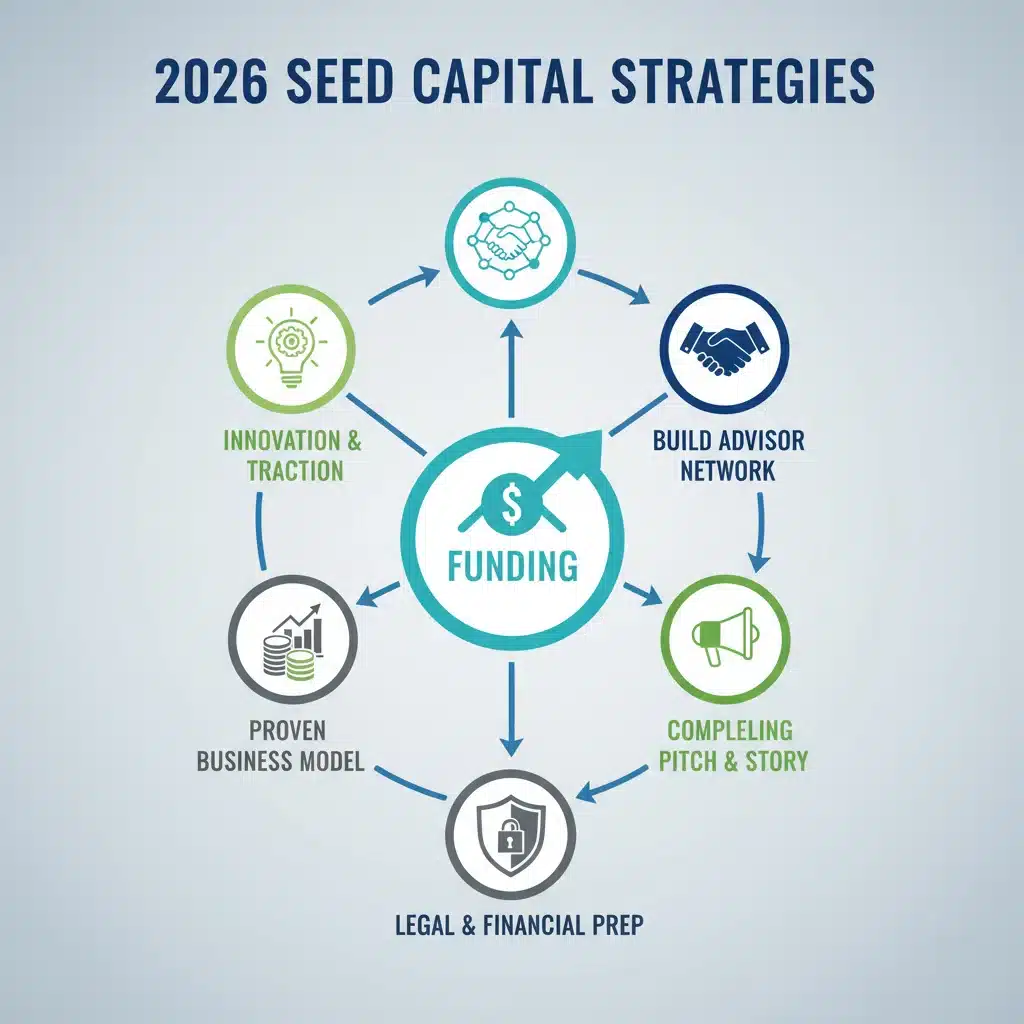
5. Emphasize Traction, Milestones, and a Clear Use of Funds
Investors providing fintech seed capital are inherently risk-averse, even at the early stage. They want to see that their investment will be used wisely and will lead to tangible progress. Therefore, clearly articulating your current traction, future milestones, and a detailed plan for the use of funds is paramount.
Showcase Early Traction and Progress: What have you achieved so far with limited resources? This could include product development progress, user sign-ups, partnership agreements, positive user feedback, or even media mentions. Any form of demonstrable progress, no matter how small, validates your team’s ability to execute and creates momentum. Highlight key performance indicators (KPIs) that are relevant to your business model and show positive trends.
Define Achievable Milestones: Clearly outline the key milestones you plan to achieve with the fintech seed capital you are seeking. These milestones should be specific, measurable, achievable, relevant, and time-bound (SMART). Examples include launching a beta product, reaching a certain number of users, securing strategic partnerships, or achieving a specific revenue target. These milestones provide investors with a clear roadmap of what to expect and how their investment will drive value.
Detailed Use of Funds: Provide a transparent breakdown of how the requested fintech seed capital will be allocated. Specific categories might include:
- Product Development: Engineering salaries, software licenses, infrastructure costs.
- Marketing & Sales: Customer acquisition campaigns, sales team hires, brand building.
- Operations: Legal and compliance fees, administrative costs, office space (if applicable).
- Team Expansion: Salaries for key hires beyond the founding team.
- Contingency: A small percentage set aside for unforeseen expenses.
Investors want to ensure their money is being used strategically to achieve the defined milestones and propel the company towards its next funding round. A vague or overly general use of funds proposal can be a red flag. Demonstrate fiscal responsibility and a clear understanding of your financial needs.
Future Funding Rounds: While focused on seed capital, it’s beneficial to briefly outline your vision for future funding rounds (e.g., Series A, Series B). This shows investors that you have a long-term strategy and a clear path to generating significant returns on their initial investment. Discuss what metrics or milestones you aim to achieve with the seed funding that will make you attractive for subsequent larger investments.
Conclusion
Raising fintech seed capital in 2026 for US startups is an intricate dance that requires more than just innovative technology. It demands meticulous preparation, strategic execution, and a deep understanding of the investor landscape. By focusing on validating your problem-solution fit, crafting a robust and scalable business model, building an exceptional team, developing a strategic fundraising plan, and emphasizing traction with a clear use of funds, fintech entrepreneurs can significantly increase their chances of securing the vital first-round funding.
The fintech sector will continue to attract significant investment, but the bar for entry for startups will only get higher. Investors are seeking not just disruption, but sustainable, compliant, and impactful solutions. By adhering to these five key strategies, US fintech startups can confidently navigate the fundraising journey, secure the necessary fintech seed capital, and lay the groundwork for a future of innovation and growth in 2026 and beyond. Prepare thoroughly, articulate your vision clearly, and demonstrate your ability to execute, and the capital you need will follow.