
US Fintech Investment Outlook 2026: Identifying High-Growth Sectors and 15% ROI Potential
The financial technology, or fintech, sector has been a beacon of innovation and growth, fundamentally reshaping how individuals and businesses interact with financial services. As we look towards 2026, the US Fintech Investment landscape promises even greater opportunities, fueled by rapid technological advancements, evolving consumer demands, and a supportive regulatory environment. This comprehensive outlook delves into the high-growth sectors poised for significant expansion, offering insights for investors aiming for an impressive 15% ROI.
The past decade has witnessed an unprecedented surge in fintech adoption, from mobile banking and digital payments to sophisticated AI-driven financial advisory platforms. This trajectory is not only expected to continue but to accelerate, driven by a post-pandemic digital transformation that has normalized virtual financial interactions. Understanding where to place your investment in this dynamic ecosystem requires a keen eye for emerging trends and a deep dive into the underlying technologies that are creating value.
For investors, the allure of fintech is undeniable. It combines the stability of the financial industry with the exponential growth potential of technology. However, navigating this complex terrain requires more than just a passing interest; it demands strategic foresight, a robust understanding of market dynamics, and an ability to identify the true disruptors. Our focus on a 15% ROI isn’t just an arbitrary target; it reflects the ambitious yet achievable returns possible within carefully selected high-growth fintech niches.
The Macro Environment Driving US Fintech Investment in 2026
Several macroeconomic factors are converging to create a fertile ground for US Fintech Investment in 2026. The continued digital transformation across all industries, coupled with a generational shift towards digital-native consumers, forms the bedrock of this growth. Younger demographics, accustomed to seamless digital experiences in other aspects of their lives, are demanding similar efficiency and personalization from their financial service providers.
Technological Advancements as Catalysts
At the heart of fintech’s expansion are relentless technological advancements. Artificial Intelligence (AI) and Machine Learning (ML) are no longer futuristic concepts but integral components of fraud detection, personalized financial advice, and automated trading. Blockchain technology, initially synonymous with cryptocurrencies, is finding broader applications in secure transactions, supply chain finance, and digital identity management. Cloud computing provides the scalable infrastructure necessary for these innovations, enabling fintech companies to rapidly deploy and iterate their services.
Evolving Regulatory Landscape
While often perceived as a challenge, the evolving regulatory landscape in the US is increasingly becoming a facilitator for fintech innovation. Regulators are striking a balance between fostering innovation and ensuring consumer protection and financial stability. Initiatives like open banking standards, while still developing in the US compared to other regions, are paving the way for greater data sharing and interoperability, which are crucial for the next wave of fintech services. Understanding these regulatory shifts is paramount for any investor in the US Fintech Investment space, as compliance can be a significant barrier to entry or a competitive advantage.
Increased Demand for Financial Inclusion and Personalization
The drive for financial inclusion, reaching underserved populations with accessible and affordable financial services, continues to be a powerful force. Fintech solutions are uniquely positioned to address this, leveraging mobile technology and data analytics to offer credit, savings, and investment products to those traditionally excluded by conventional banking. Concurrently, consumers across all segments are demanding highly personalized financial experiences, moving away from one-size-fits-all banking towards tailored advice and products that meet their specific needs. This trend fuels investment in AI-driven platforms and data analytics capabilities.
Identifying High-Growth Sectors for 15% ROI in US Fintech
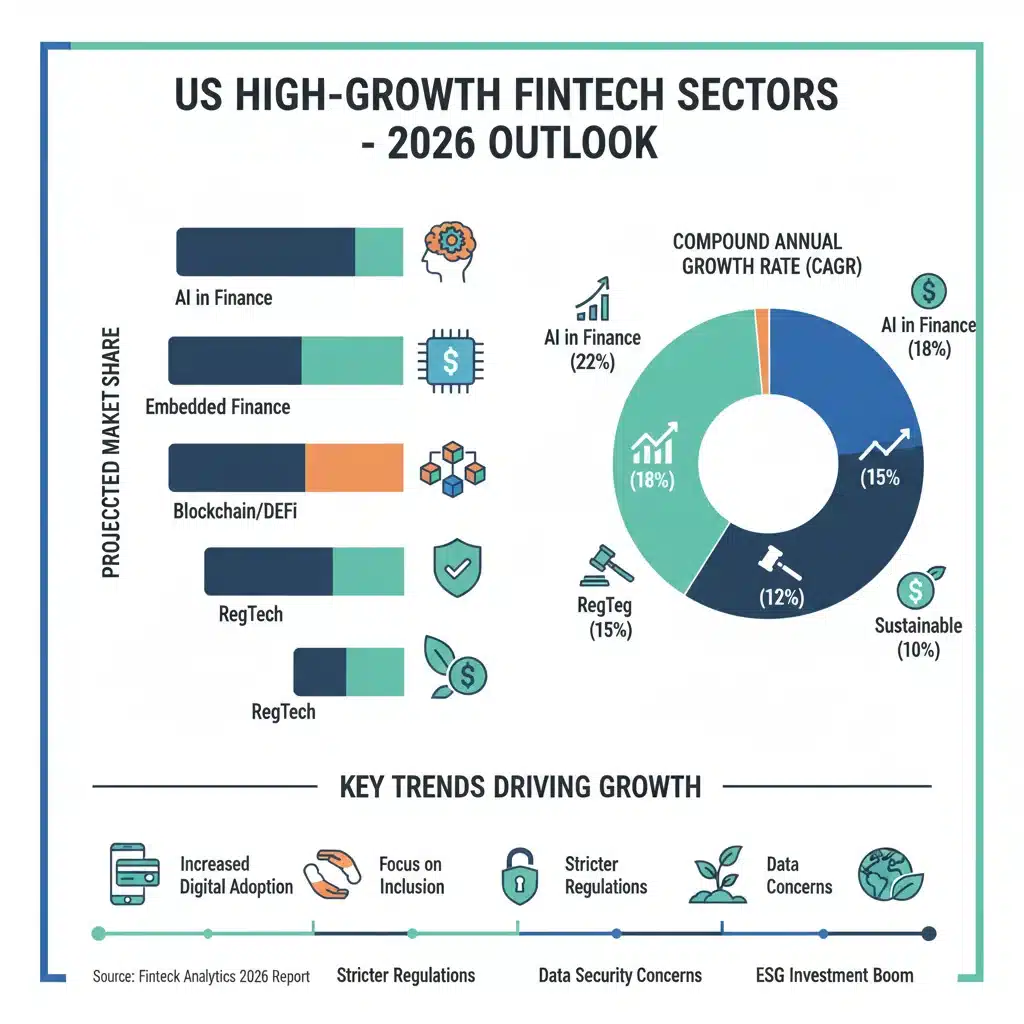
To achieve a 15% ROI in the US Fintech Investment market by 2026, investors must pinpoint sectors demonstrating not just growth, but sustainable, disruptive growth. Here are some of the most promising areas:
1. Embedded Finance: Seamless Integration is Key
Embedded finance refers to the integration of financial services directly into non-financial platforms and apps. Think ‘Buy Now, Pay Later’ (BNPL) options at e-commerce checkouts, or insurance products offered directly within a car-buying process. This sector is exploding because it removes friction from financial transactions, making them more convenient and contextual. Companies that excel in providing these white-label financial solutions, or those that leverage them effectively, are ripe for investment. The market for embedded finance is projected to grow significantly, driven by its ability to enhance customer experience and open new revenue streams for non-financial businesses.
2. AI and Machine Learning in Financial Services: Beyond Automation
AI and ML are no longer just about automating back-office tasks. In 2026, their impact will be felt across predictive analytics for market trends, advanced fraud detection systems that learn and adapt, hyper-personalized financial advisory bots (robo-advisors), and sophisticated credit scoring models that assess risk with greater accuracy and inclusivity. Investing in companies developing proprietary AI/ML algorithms or platforms that offer these capabilities as a service will be highly lucrative. The ability of AI to process vast datasets and identify complex patterns will be a key differentiator for successful fintech firms.
3. Blockchain and Distributed Ledger Technology (DLT): Beyond Crypto
While cryptocurrencies capture headlines, the real long-term US Fintech Investment opportunity in blockchain lies in its underlying technology. DLT offers unparalleled security, transparency, and efficiency for recording transactions and managing data. We anticipate significant growth in enterprise blockchain solutions for supply chain finance, cross-border payments, digital identity verification, and tokenized assets. Companies building scalable, interoperable blockchain infrastructure and applications that solve real-world financial problems are poised for substantial returns.
4. Regtech (Regulatory Technology): Navigating Compliance Complexity
As financial regulations become more complex and data privacy concerns intensify, the demand for Regtech solutions will soar. Regtech companies leverage AI, ML, and big data to automate compliance processes, monitor transactions for illicit activities, and manage risk more effectively. This sector offers a defensive yet high-growth investment, as financial institutions are compelled to adopt these technologies to avoid hefty fines and reputational damage. Solutions that offer real-time compliance monitoring and predictive regulatory intelligence will be particularly valuable.
5. Cybersecurity in Financial Services: The Unseen Shield
With increasing digitization comes increased cyber risk. Data breaches and cyberattacks can have catastrophic consequences for financial institutions and their customers. Consequently, cybersecurity fintechs, specializing in protecting financial data, transactions, and infrastructure, are becoming indispensable. Investment in advanced encryption, biometric authentication, threat intelligence platforms, and secure multi-party computation will see significant returns. This is a foundational sector; without robust cybersecurity, the growth of other fintech areas would be unsustainable.
6. Neobanks and Digital-First Banking: Redefining Customer Experience
Neobanks, or challenger banks, operating entirely online without physical branches, continue to disrupt traditional banking by offering superior digital experiences, lower fees, and innovative features. While the market is becoming more crowded, those neobanks that successfully carve out niche markets (e.g., specific demographics, small businesses) or offer truly differentiated services (e.g., advanced budgeting tools, integrated investment platforms) will continue to thrive. Their ability to rapidly adapt to customer needs and leverage technology efficiently positions them for continued growth in the US Fintech Investment landscape.
Strategies for Achieving a 15% ROI in US Fintech
Achieving a 15% ROI in the dynamic US Fintech Investment market requires a multifaceted approach. It’s not just about picking the right sector, but also about understanding the nuances of investment and portfolio management in this space.
Due Diligence and Market Analysis
Thorough due diligence is non-negotiable. This goes beyond financial statements to evaluating a company’s technology stack, its competitive moat, the experience of its leadership team, and its go-to-market strategy. For fintechs, particular attention should be paid to data security protocols, regulatory compliance frameworks, and scalability of their platforms. Market analysis should include understanding the specific pain points the fintech addresses, the size of its target market, and the competitive landscape.
Diversification Across Sub-Sectors and Stages
While focusing on high-growth areas, diversification remains crucial. Spreading investments across different fintech sub-sectors (e.g., embedded finance, regtech, AI in finance) can mitigate risks associated with any single area. Furthermore, considering companies at different stages of growth – from promising early-stage startups to more established scale-ups – can balance risk and return profiles. Early-stage investments offer higher potential returns but come with increased risk, while later-stage companies might offer more stable, albeit potentially lower, growth.
Understanding the Regulatory Environment
The regulatory environment can make or break a fintech company. Investors must assess a company’s ability to navigate current regulations and adapt to future changes. Companies with strong legal and compliance teams, or those whose business models are inherently compliant, will have a significant advantage. Proactive engagement with regulators, where possible, can also be a positive indicator.

Focus on Scalability and Sustainable Business Models
Fintechs with highly scalable business models are more likely to achieve exponential growth. Look for companies with low customer acquisition costs, high retention rates, and technology that can handle increasing transaction volumes without significant additional investment. Recurring revenue models, such as subscriptions or transaction fees, are often more attractive than one-off sales, as they provide greater predictability and stability. A sustainable business model also considers the long-term competitive advantages, such as network effects or proprietary technology, that prevent easy replication.
Evaluating Management Teams and Vision
In the fast-paced world of fintech, the quality of the management team is paramount. Look for experienced leaders with a proven track record, deep industry knowledge, and a clear vision for the future. A strong team can adapt to market changes, overcome challenges, and attract top talent, all of which are critical for success. Their ability to articulate a compelling value proposition and execute on their strategy is a key indicator of potential success in the US Fintech Investment arena.
Potential Challenges and Risks in US Fintech Investment
While the opportunities are vast, investors must also be aware of the inherent challenges and risks in US Fintech Investment. Mitigating these risks is essential for achieving the targeted 15% ROI.
Intense Competition and Market Saturation
The success of fintech has attracted a multitude of players, leading to intense competition in certain sub-sectors. This can drive up customer acquisition costs and compress margins. Investors need to identify companies with strong differentiation, unique value propositions, and solid competitive moats that can withstand market pressures.
Regulatory Uncertainty and Compliance Burden
Despite efforts to create a more supportive regulatory environment, uncertainty remains. New regulations can emerge rapidly, requiring significant adjustments from fintech companies. The cost of compliance, especially for smaller startups, can be substantial. Investing in companies with robust compliance strategies and adaptable technological infrastructures is key.
Cybersecurity Threats and Data Privacy Concerns
As mentioned, cybersecurity is a double-edged sword. While it presents investment opportunities, it also poses a significant risk. A major data breach can severely damage a fintech company’s reputation, lead to legal liabilities, and erode customer trust. Investors must thoroughly vet a company’s cybersecurity measures and data privacy policies.
Economic Downturns and Funding Challenges
Like any sector, fintech is not immune to broader economic downturns. During periods of economic contraction, consumer spending on certain financial services might decrease, and access to capital for startups could become more challenging. While fintech has shown resilience, a diversified portfolio and a focus on companies with strong balance sheets and clear paths to profitability can help weather such storms.
Talent Acquisition and Retention
The demand for skilled fintech professionals – combining expertise in finance, technology, and data science – far outstrips supply. Attracting and retaining top talent is a constant challenge for fintech companies. Companies with strong culture, competitive compensation packages, and a clear mission are better positioned to succeed.
The Future Landscape: Beyond 2026
Looking beyond 2026, the US Fintech Investment trajectory suggests an even more integrated and intelligent financial ecosystem. We can anticipate further blurring of lines between traditional financial institutions and fintechs, leading to more partnerships and acquisitions. The rise of Web3 technologies, including decentralized finance (DeFi) and the metaverse, could unlock entirely new paradigms for financial interactions, albeit with significant regulatory and technological hurdles to overcome.
Personalized finance will become even more sophisticated, with AI agents managing entire financial lives, from budgeting and investments to insurance and retirement planning. The focus will shift from just providing financial products to offering holistic financial well-being solutions. This evolution will open up new investment avenues in areas like behavioral finance tech, advanced AI-driven financial planning, and specialized digital asset management platforms.
Global expansion will also remain a key theme. Successful US fintech models will increasingly look to replicate their success in international markets, particularly those with nascent digital financial infrastructure. This presents opportunities for investors to back companies with strong global ambitions and adaptable technologies.
Conclusion: Seizing the 15% ROI Opportunity in US Fintech
The US Fintech Investment outlook for 2026 is exceptionally bright, offering compelling opportunities for investors seeking substantial returns. By focusing on high-growth sectors such as embedded finance, AI/ML in financial services, blockchain, regtech, cybersecurity, and neobanks, investors can strategically position themselves to achieve a 15% ROI. Success hinges on rigorous due diligence, strategic diversification, a deep understanding of the regulatory environment, and an unwavering focus on scalable, sustainable business models and strong leadership teams.
While challenges like intense competition and regulatory uncertainty exist, the transformative power of technology and the ever-evolving demands of consumers will continue to fuel innovation and growth in the fintech space. For those prepared to navigate its complexities, the US fintech market in 2026 is not just a landscape of potential but a realm of tangible financial impact.
Embrace the future of finance; the opportunities for smart US Fintech Investment are here.