
Fintech Partnerships 2026: Accelerating US Market Growth by 20%
The financial technology (fintech) landscape in the United States is evolving at an unprecedented pace. For startups in this dynamic sector, achieving significant market penetration and sustainable growth is a monumental challenge. However, a powerful strategy is emerging as a cornerstone for success: Fintech Strategic Partnerships. In 2026, these collaborations are not just an option but a necessity for driving a projected 20% faster market penetration, unlocking new opportunities, and navigating the complexities of a highly regulated and competitive environment.
The promise of fintech lies in its ability to disrupt traditional financial services, offering innovative solutions that are more efficient, accessible, and user-friendly. Yet, building trust, scaling operations, and complying with stringent regulations can quickly exhaust a startup’s resources. This is where strategic alliances become invaluable. By partnering with established institutions, fellow innovators, or even non-financial entities, fintech startups can overcome critical hurdles, leverage existing infrastructures, and accelerate their journey from nascent idea to market leader. This article delves deep into the mechanisms, benefits, and future trends of Fintech Strategic Partnerships, providing a comprehensive guide for US startups aiming for exponential growth in the coming year.
The Imperative of Fintech Strategic Partnerships in 2026
The year 2026 marks a pivotal moment for the US fintech industry. Economic shifts, technological advancements, and evolving consumer expectations are creating both immense opportunities and significant pressures. Startups that attempt to go it alone often find themselves struggling against established giants with deep pockets and extensive customer bases. Fintech Strategic Partnerships offer a crucial pathway to level the playing field, providing access to resources, expertise, and markets that would otherwise be out of reach.
Why Partnerships are Key for Market Penetration
- Access to Customer Bases: One of the most immediate benefits of partnering, especially with traditional financial institutions (FIs), is gaining access to their vast customer networks. A startup might have a revolutionary product, but acquiring millions of users from scratch is incredibly expensive and time-consuming. A partnership can instantly provide a ready-made audience.
- Credibility and Trust: New fintech companies often face skepticism, particularly concerning security and reliability. Aligning with a reputable, established partner can lend instant credibility, boosting consumer confidence and accelerating adoption.
- Regulatory Navigation: The financial sector is heavily regulated. Navigating this labyrinth can be a significant drain on startup resources. Partners with existing regulatory frameworks and compliance expertise can guide startups, ensuring adherence to complex laws and reducing legal risks.
- Technology Integration: Many partnerships involve integrating a startup’s innovative technology into a partner’s existing infrastructure. This not only streamlines deployment but also allows the startup to focus on core innovation rather than building out extensive proprietary systems from the ground up.
- Capital Efficiency: Scaling a fintech solution requires substantial capital for development, marketing, and infrastructure. Strategic alliances can reduce the need for excessive fundraising by sharing costs, leveraging partner resources, or even attracting investment from the partner itself. This capital efficiency directly contributes to faster market penetration by allowing more resources to be allocated to growth initiatives.
Beyond these immediate advantages, Fintech Strategic Partnerships foster an ecosystem of shared innovation. By combining diverse perspectives and capabilities, partners can co-create solutions that are more robust, comprehensive, and impactful than any single entity could achieve alone. This collaborative spirit is essential for staying ahead in a rapidly changing market.
Types of Strategic Partnerships for US Fintech Startups
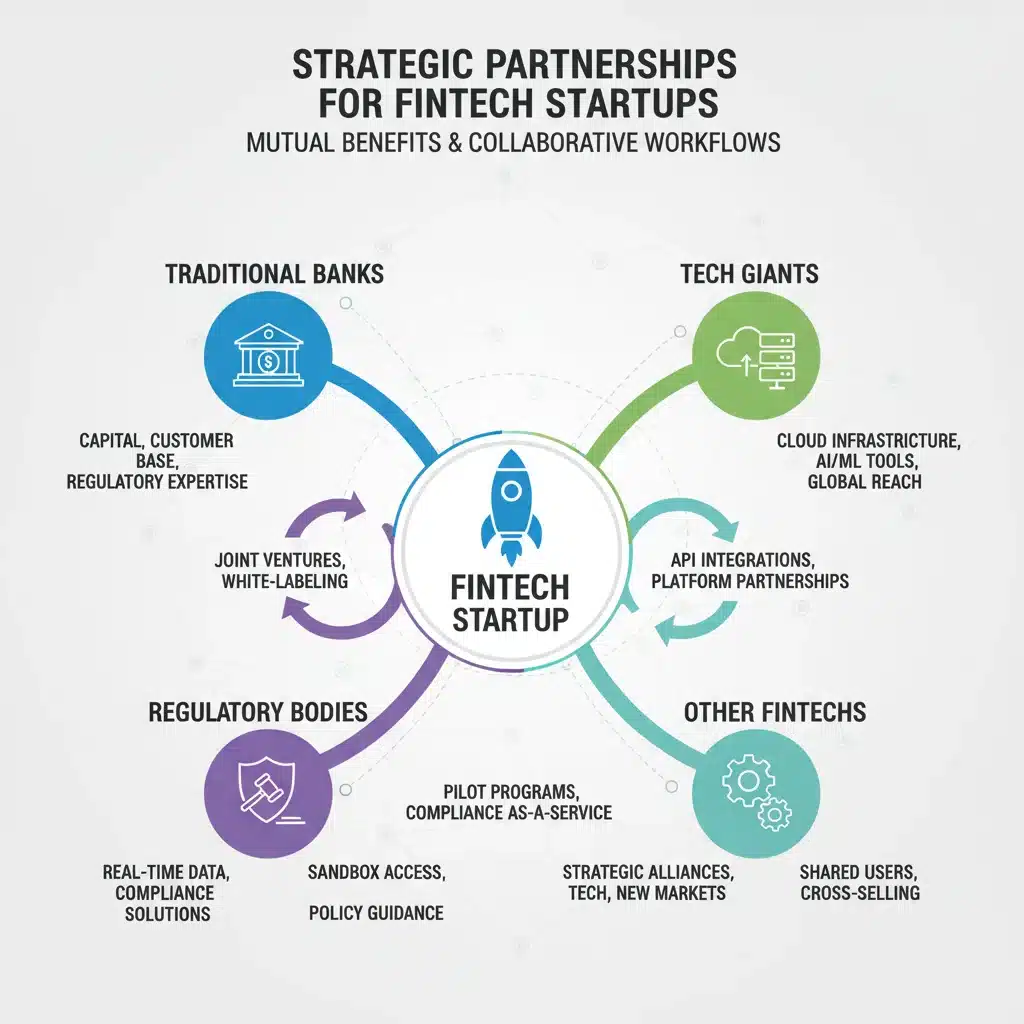
The landscape of potential partners is diverse, each offering unique benefits. Understanding the different types of Fintech Strategic Partnerships is crucial for identifying the best fit for a startup’s specific goals and stage of development.
1. Bank-Fintech Collaborations
These are perhaps the most common and impactful partnerships. Traditional banks, facing pressure from agile fintechs, are increasingly open to collaborating rather than competing. For fintechs, banks offer a massive customer base, regulatory expertise, and significant capital. For banks, fintechs bring innovation, modern technology, and a fresh approach to customer experience.
- Examples: White-labeling fintech solutions, co-developing new products (e.g., digital lending platforms, AI-powered fraud detection), integrating payment processing solutions, or even minority investments by banks in fintech startups.
- Benefits: Immediate access to millions of customers, regulatory guidance, enhanced credibility, and potential funding.
- Challenges: Cultural differences, slower decision-making processes in large banks, and potential for intellectual property disputes.
2. Tech Giant Alliances
Companies like Google, Apple, Amazon, and Meta are increasingly venturing into financial services. Partnerships with these tech behemoths can offer unparalleled reach, advanced technological infrastructure (cloud services, AI, machine learning), and vast data analytics capabilities.
- Examples: Integrating fintech payment solutions into e-commerce platforms, leveraging AI for personalized financial advice, or using cloud infrastructure for scalable operations.
- Benefits: Access to cutting-edge technology, enormous user bases, global reach, and robust infrastructure.
- Challenges: Potential for being overshadowed, data privacy concerns, and aligning with the tech giant’s broader strategic objectives.
3. Fintech-to-Fintech Collaborations
Sometimes, the best partners are other fintech companies. These alliances can create synergistic solutions, where each company brings a specialized product or service to the table, resulting in a more comprehensive offering for the end-user.
- Examples: A personal finance management app partnering with a micro-investing platform, or a blockchain-based lending solution integrating with a digital identity verification service.
- Benefits: Complementary services, shared innovation, mutual customer acquisition, and enhanced value proposition.
- Challenges: Defining clear boundaries, potential for future competition, and ensuring seamless integration of disparate technologies.
4. Non-Financial Corporate Partnerships
Beyond the traditional financial ecosystem, opportunities exist with companies in other sectors. Retailers, telecommunications providers, and even healthcare companies are exploring embedded finance and other fintech integrations to enhance their customer offerings.
- Examples: A retail chain offering ‘buy now, pay later’ options through a fintech partner, or a telecom company providing mobile banking services.
- Benefits: Tapping into new markets, creating novel use cases for fintech products, and diversifying revenue streams.
- Challenges: Understanding the partner’s core business, ensuring regulatory compliance across different industries, and aligning customer experience expectations.
Crafting a Successful Fintech Strategic Partnership Strategy
Identifying the right partner is only the first step. A well-defined strategy is essential to ensure the partnership yields the desired outcomes, particularly the accelerated market penetration goals for 2026.
1. Define Clear Objectives and KPIs
Before approaching any potential partner, clearly articulate what you aim to achieve. Is it customer acquisition, product diversification, regulatory compliance, or technological enhancement? Establish measurable Key Performance Indicators (KPIs) to track success. For instance, aiming for a 20% increase in market share within 12 months through the partnership provides a tangible target.
2. Identify Complementary Strengths and Weaknesses
The most effective partnerships are built on synergy. Each party should bring unique strengths that address the other’s weaknesses. A startup might offer agility and innovation, while a bank provides scale and trust. A thorough internal assessment and external market analysis are crucial here.
3. Due Diligence and Cultural Alignment
Beyond financial and technical assessments, cultural fit is paramount. Misaligned organizational cultures can lead to friction, delays, and ultimately, failure. Invest time in understanding a potential partner’s values, decision-making processes, and communication styles. Due diligence should also cover legal, regulatory, and reputational aspects.
4. Structure the Agreement Carefully
The partnership agreement should be comprehensive, detailing roles, responsibilities, revenue sharing models, intellectual property rights, data sharing protocols, and exit strategies. Legal counsel specializing in fintech and corporate partnerships is indispensable to protect both parties’ interests.
5. Foster Open Communication and Collaboration
Successful partnerships thrive on transparency and continuous dialogue. Establish regular communication channels, joint working groups, and a clear escalation path for resolving issues. A collaborative mindset is vital for navigating the inevitable challenges that arise in any complex alliance.
6. Phased Implementation and Iteration
Instead of attempting a massive overhaul, consider a phased approach. Start with a pilot program or a specific project to test the waters, learn, and iterate. This allows for adjustments based on real-world outcomes and builds confidence between partners before committing to larger initiatives. This iterative process is key to achieving a 20% faster market penetration, as it allows for rapid adaptation to market feedback.
Future Trends Shaping Fintech Strategic Partnerships in 2026
As we look towards 2026, several trends will significantly influence the nature and scope of Fintech Strategic Partnerships. Startups that anticipate these shifts will be better positioned to forge impactful alliances.
1. Embedded Finance Everywhere
The integration of financial services directly into non-financial platforms will continue to accelerate. This means more partnerships between fintechs and companies in sectors like retail, automotive, healthcare, and software-as-a-service (SaaS). Fintechs providing APIs and modular financial components will be highly sought after.
2. Focus on Data-Driven Personalization
Consumers expect hyper-personalized experiences. Partnerships that combine a fintech’s analytical capabilities with a partner’s vast customer data (with appropriate privacy safeguards) will be crucial for delivering tailored financial products and advice. AI and machine learning will be at the core of these collaborations.
3. Rise of BaaS (Banking-as-a-Service)
BaaS platforms enable non-banks to offer banking services through APIs. This trend will simplify partnerships, allowing fintechs to easily integrate banking functionalities without the need for extensive regulatory licenses themselves. Expect more fintechs to partner with BaaS providers to launch innovative products quickly.
4. Cybersecurity and Fraud Prevention Alliances
With the increasing sophistication of cyber threats, robust security is paramount. Fintechs specializing in advanced cybersecurity, fraud detection, and digital identity verification will find strong demand for partnerships with all types of financial institutions and tech companies. Collaborative efforts to share threat intelligence will also become more common.

5. ESG (Environmental, Social, Governance) Driven Partnerships
As consumers and investors increasingly prioritize sustainability, partnerships focused on ESG-compliant financial products and services will gain traction. Fintechs offering green investments, ethical lending, or social impact platforms will find partners eager to enhance their ESG credentials.
6. Global Expansion through Local Partnerships
US fintechs looking to expand internationally will increasingly rely on local strategic partners to navigate foreign markets, regulatory landscapes, and cultural nuances. These partnerships will be vital for efficient and effective global market penetration.
Overcoming Challenges in Fintech Strategic Partnerships
While the benefits are substantial, Fintech Strategic Partnerships are not without their challenges. Addressing these proactively is critical for success.
1. Cultural Clash
Large, established institutions often have slower decision-making processes and risk-averse cultures compared to agile, fast-moving startups. Bridging this gap requires patience, clear communication, and a willingness from both sides to adapt. Establishing dedicated innovation labs or joint venture entities can help create a ‘neutral’ cultural ground.
2. Regulatory Hurdles
Regulatory compliance can be a minefield. Partners must work together to ensure that integrated solutions meet all legal requirements. This often involves extensive legal review and sometimes even direct engagement with regulatory bodies to seek clarity or approvals.
3. Data Sharing and Security
Sharing sensitive financial data between partners raises significant privacy and security concerns. Robust data governance frameworks, encryption protocols, and clear data usage agreements are essential to protect customer information and maintain trust.
4. Integration Complexities
Integrating disparate technological systems can be technically challenging and time-consuming. API-first approaches, clear technical documentation, and dedicated integration teams are vital to ensure seamless interoperability and avoid delays that could hinder market penetration goals.
5. Intellectual Property (IP) Ownership
Clearly defining ownership and usage rights for any co-developed intellectual property is critical. This should be a central component of the partnership agreement to prevent future disputes.
The 20% Faster Market Penetration Goal: A Realistic Outlook
The aspiration for 20% faster market penetration through Fintech Strategic Partnerships in 2026 is ambitious but entirely achievable. This acceleration won’t come from a single partnership but rather a portfolio of well-executed alliances. By meticulously selecting partners, defining clear objectives, and fostering a spirit of genuine collaboration, US fintech startups can leverage these relationships to:
- Rapidly Expand User Base: Gaining access to millions of customers through a bank partnership, for example, can instantly multiply a startup’s reach.
- Accelerate Product Development Cycles: By sharing R&D costs and expertise, new features and products can be brought to market much faster.
- Reduce Time-to-Market: Leveraging a partner’s existing distribution channels and regulatory approvals significantly shortens the time it takes to launch and scale.
- Enhance Brand Recognition and Trust: Associating with established brands builds confidence, reducing the sales cycle and increasing adoption rates.
- Optimize Resource Allocation: By offloading non-core functions or leveraging partner infrastructure, startups can focus their limited resources on core innovation and growth strategies.
The cumulative effect of these advantages creates a powerful flywheel effect, propelling startups into new markets and customer segments with unparalleled speed. The key is to view partnerships not as transactional agreements but as long-term strategic alignments designed for mutual growth and shared success.
Conclusion: Paving the Way for a Collaborative Fintech Future
In conclusion, the future of US fintech in 2026 is undeniably collaborative. For startups aiming to achieve a remarkable 20% faster market penetration, embracing Fintech Strategic Partnerships is not merely an advantage; it is a fundamental pillar of their growth strategy. These alliances offer a potent combination of expanded reach, enhanced credibility, accelerated innovation, and streamlined regulatory navigation.
By carefully identifying complementary partners, meticulously structuring agreements, and fostering cultures of open communication and shared objectives, fintech startups can unlock unprecedented opportunities. The challenges, though real, are surmountable with proactive planning and a commitment to mutual success. As the financial landscape continues its rapid transformation, those who master the art of strategic collaboration will be the ones that not only survive but thrive, leading the charge in shaping the next generation of financial services in the United States.
The journey to 20% faster market penetration is an exciting one, paved with innovation, collaboration, and a clear vision for a more inclusive and efficient financial future, powered by smart Fintech Strategic Partnerships.