
The 3-Month Sprint: Accelerating Fintech User Acquisition for US Fintech Startups in a Competitive 2026 Market
The US fintech landscape in 2026 is an exhilarating, yet incredibly challenging, arena. For startups, the race to acquire users isn’t just about growth; it’s about survival and establishing a formidable market presence. With innovation accelerating and competition intensifying, a strategic, rapid-fire approach to fintech user acquisition is no longer a luxury but an absolute necessity. This comprehensive guide will outline a practical 3-month sprint strategy designed to propel US fintech startups toward aggressive user growth, focusing on actionable steps, data-driven decisions, and sustainable practices.
The digital financial services sector is characterized by ever-evolving consumer expectations, stringent regulatory frameworks, and a constant influx of new players. In such an environment, merely having a groundbreaking product isn’t enough. Startups must master the art and science of attracting, engaging, and retaining users at an unprecedented pace. Our 3-month sprint framework is engineered to cut through the noise, optimize resource allocation, and deliver measurable results, ensuring your fintech venture not only competes but thrives.
This article delves deep into each phase of the sprint, from initial market analysis and audience segmentation to channel optimization, performance marketing, and the critical role of product-led growth and partnerships. We’ll explore how to leverage cutting-edge analytics, foster community, and adapt swiftly to market feedback. By the end, you’ll have a clear roadmap to execute a high-impact fintech user acquisition campaign that positions your startup for long-term success in the dynamic 2026 market.
Month 1: Foundation & Hyper-Targeting for Fintech User Acquisition
The initial month of your fintech user acquisition sprint is all about laying a robust, data-driven foundation. This phase is critical for understanding your market, identifying your ideal users, and crafting a compelling value proposition that resonates deeply. Without this groundwork, subsequent marketing efforts risk being unfocused and inefficient.
1.1 Deep Dive into Market Research & Competitive Analysis
Before you can acquire users, you must understand the landscape they inhabit. This involves a meticulous analysis of the US fintech market. What are the prevailing trends? Which regulatory changes are on the horizon? More importantly, who are your direct and indirect competitors? Analyze their strengths, weaknesses, marketing strategies, and user acquisition channels. Identify gaps in their offerings that your product can uniquely fill.
- Tools & Techniques: Utilize market intelligence platforms (e.g., CB Insights, FinTech Global), conduct SWOT analysis on competitors, read industry reports, and analyze public financial data.
- Key Output: A detailed competitive landscape report, identification of market white spaces, and a clear understanding of industry benchmarks for fintech user acquisition costs and conversion rates.
1.2 Define Your Ideal Customer Profile (ICP) & Persona Development
Hyper-targeting is the cornerstone of efficient fintech user acquisition. Instead of casting a wide net, focus on the users most likely to benefit from and adopt your product. Develop detailed Ideal Customer Profiles (ICPs) and user personas. Go beyond demographics; delve into psychographics, financial behaviors, pain points, aspirations, and digital habits. What financial problems does your product solve for them? How do they currently manage their finances?
- Tools & Techniques: Conduct surveys, interviews with potential users, analyze existing customer data (if available), and use social listening tools.
- Key Output: 2-3 detailed user personas, including their financial goals, challenges, preferred communication channels, and motivations for using a fintech product. This will guide all subsequent marketing and product development efforts.
1.3 Crafting a Compelling Value Proposition & Messaging
Once you know who you’re talking to, you need to know what to say. Your value proposition must clearly articulate the unique benefits and solutions your fintech product offers to your ICPs. It should be concise, memorable, and differentiate you from competitors. Develop core messaging frameworks that highlight these unique selling points (USPs) across all communication channels.
- Tools & Techniques: Value Proposition Canvas, A/B testing headlines and taglines, user feedback sessions.
- Key Output: A crystal-clear value proposition statement and a messaging matrix that adapts your core message for different channels and personas, crucial for effective fintech user acquisition campaigns.
1.4 Initial Channel Strategy & Budget Allocation
Based on your ICPs and competitive analysis, identify the most promising acquisition channels. For fintech, these often include a mix of performance marketing (paid social, search), content marketing, PR, influencer marketing, and strategic partnerships. Allocate an initial budget, understanding that this will be dynamic and optimized throughout the sprint.
- Tools & Techniques: Customer journey mapping to identify touchpoints, channel cost analysis, and setting initial KPIs for each channel.
- Key Output: A preliminary channel strategy document with estimated budgets and expected return on ad spend (ROAS) or customer acquisition cost (CAC) targets.
Month 2: Execution, Experimentation & Optimization
Month two is where the rubber meets the road. With a solid foundation from month one, this phase focuses on launching your initial campaigns, rigorously testing hypotheses, and optimizing performance based on real-world data. Agility and a willingness to iterate rapidly are paramount for successful fintech user acquisition.
2.1 Launching Performance Marketing Campaigns (Paid Social & Search)
Performance marketing channels like Facebook/Instagram Ads, Google Ads, and increasingly TikTok/LinkedIn Ads are essential for direct response and scalable fintech user acquisition. Leverage the persona data to create highly targeted ad sets with compelling creatives and copy.
- Paid Social: Focus on audience segmentation (demographics, interests, behaviors, custom audiences), A/B test ad creatives (images, videos, carousels), ad copy, and calls-to-action (CTAs). Utilize lead generation forms or direct-to-app/website links.
- Search Engine Marketing (SEM): Target high-intent keywords related to your fintech solution. Optimize ad copy for relevance and clarity. Implement robust conversion tracking.
- Key Output: Live campaigns on selected platforms, daily monitoring of key metrics (CTR, CVR, CAC, ROAS), and initial optimization reports.
2.2 Content Marketing & SEO for Organic Growth
While performance marketing delivers immediate results, content marketing and SEO build long-term organic authority and trust, crucial for sustainable fintech user acquisition. Create valuable content that addresses your ICP’s financial pain points and interests.
- Blog Posts & Guides: Develop evergreen content around financial literacy, product use cases, and industry insights. Optimize for relevant keywords.
- Video Content: Short, engaging videos explaining complex financial concepts or product features can perform exceptionally well on platforms like YouTube and TikTok.
- SEO Optimization: Ensure your website and landing pages are technically sound, mobile-friendly, and optimized for target keywords. Build high-quality backlinks.
- Key Output: A content calendar, published articles/videos, and initial organic traffic and keyword ranking reports.
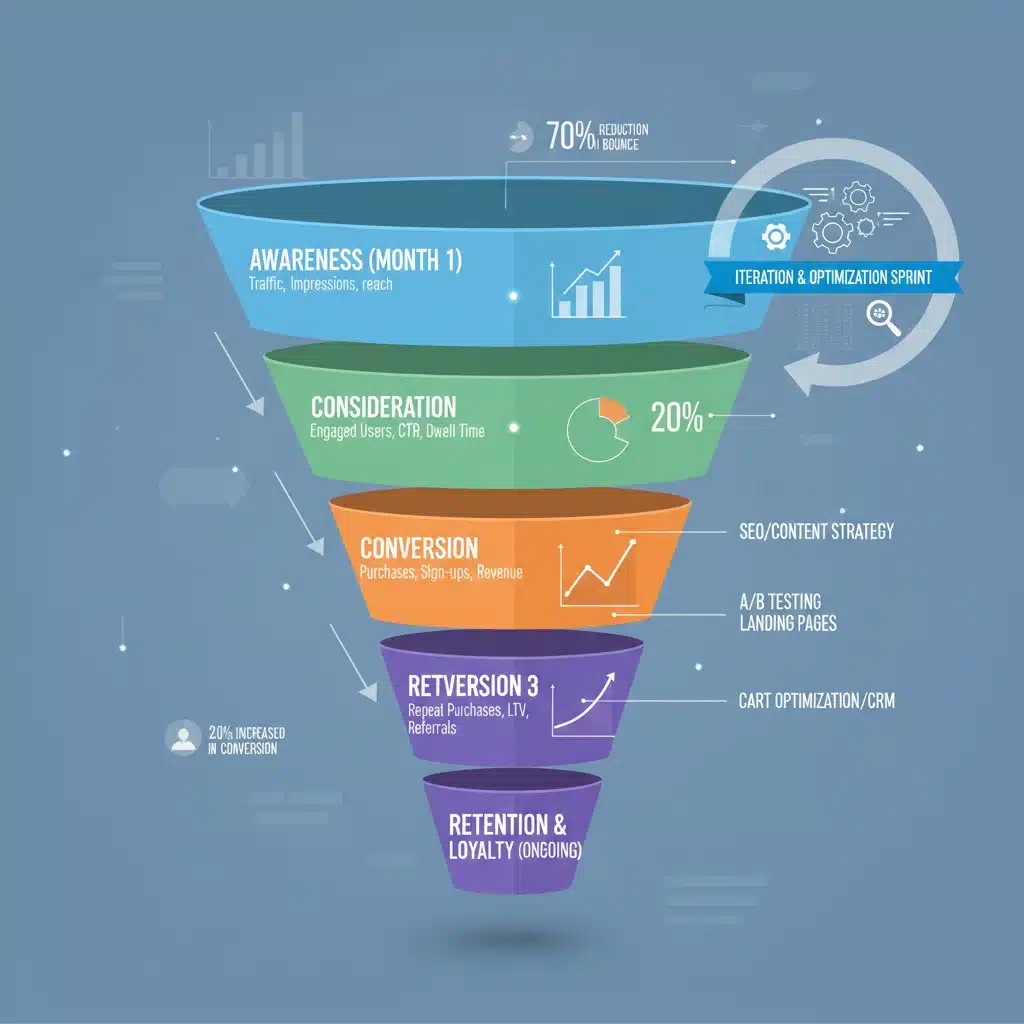
2.3 A/B Testing & Conversion Rate Optimization (CRO)
Continuous testing is the lifeblood of effective fintech user acquisition. A/B test everything: landing page layouts, CTA buttons, form fields, messaging, and even onboarding flows. Small improvements in conversion rates can significantly impact your overall acquisition volume and efficiency.
- Tools & Techniques: Google Optimize, Optimizely, Hotjar (for heatmaps and session recordings).
- Focus Areas: Landing page performance, sign-up forms, initial product experience (onboarding).
- Key Output: A/B test results, identified winning variations, and implemented changes leading to improved conversion rates.
2.4 Data Analytics & Reporting
Establish robust tracking and reporting mechanisms from day one. Utilize tools like Google Analytics, Amplitude, Mixpanel, or custom dashboards to monitor user behavior, campaign performance, and acquisition costs in real-time. Regular reporting sessions are essential to quickly identify what’s working and what’s not.
- Key Metrics: CAC (Customer Acquisition Cost), LTV (Lifetime Value), CVR (Conversion Rate), CTR (Click-Through Rate), Retention Rate, Churn Rate.
- Key Output: Weekly performance reports, identification of underperforming channels/campaigns, and data-backed recommendations for optimization.
Month 3: Scaling, Retention & Strategic Partnerships
The final month of the sprint shifts focus from pure acquisition to sustainable growth. This involves scaling successful campaigns, improving user retention, and forging strategic alliances that can provide exponential growth in fintech user acquisition. It’s also a period for refining your product based on initial user feedback.
3.1 Scaling Successful Channels & Campaigns
Based on the data from month two, double down on the channels and campaigns that have demonstrated the lowest CAC and highest LTV. Incrementally increase budgets while closely monitoring performance to avoid diminishing returns. Explore lookalike audiences and similar targeting strategies to expand your reach within proven segments.
- Strategy: Gradual budget increases, audience expansion, and multivariate testing of winning ad variations.
- Key Output: Scaled campaigns delivering increased user volume within target CAC.
3.2 Product-Led Growth (PLG) & Onboarding Optimization
For fintech, the product itself is a powerful acquisition and retention tool. Focus on optimizing the user journey from sign-up to first value. A seamless, intuitive onboarding experience can significantly reduce churn and boost organic referrals. Integrate features that encourage early engagement and demonstrate immediate value.
- User Feedback: Solicit feedback from early adopters through surveys, in-app prompts, and user interviews.
- In-App Guidance: Implement tooltips, walkthroughs, and personalized recommendations to guide users.
- Referral Programs: Design attractive referral programs that incentivize existing users to invite new ones, a highly effective fintech user acquisition strategy.
- Key Output: Improved onboarding flows, increased early user engagement metrics, and a launched referral program.

3.3 Strategic Partnerships & Influencer Marketing
Partnerships can unlock new user segments and build credibility. Identify complementary businesses, financial institutions, or community organizations that share your target audience. This could involve co-marketing, API integrations, or joint ventures. Similarly, engage with fintech influencers or financial educators who can authentically promote your product to their audience.
- Types of Partnerships: B2B integrations, co-branded content, affiliate marketing, community sponsorships.
- Influencer Selection: Focus on micro- and nano-influencers with engaged audiences relevant to your niche.
- Key Output: Established partnership agreements, launched co-marketing campaigns, and influencer-generated content.
3.4 Retention Strategies & Community Building
Acquiring users is only half the battle; retaining them is equally, if not more, important for long-term success. Implement strategies to keep users engaged and loyal. Foster a sense of community around your brand.
- Personalized Communication: Use email marketing and in-app notifications to deliver personalized financial insights, product updates, and educational content.
- Customer Support: Provide exceptional, responsive customer service to address user issues promptly.
- Community Platforms: Create forums, social media groups, or virtual events where users can connect, share experiences, and receive support.
- Key Output: Increased user retention rates, positive user reviews, and a growing brand community.
Key Success Factors for Your Fintech User Acquisition Sprint
Beyond the tactical steps, several overarching principles will dictate the success of your 3-month fintech user acquisition sprint:
Agility & Iteration
The fintech market moves fast. Your team must be agile, willing to pivot strategies based on data, and embrace a culture of continuous experimentation. What works today might not work tomorrow, so constant adaptation is key.
Data-Driven Decision Making
Every decision, from channel selection to messaging tweaks, should be backed by data. Establish clear KPIs, robust tracking, and regular analytics reviews to ensure you’re always optimizing for the best possible outcomes.
Cross-Functional Collaboration
User acquisition isn’t solely a marketing function. Product, engineering, sales, and customer support teams must work in seamless collaboration. Product insights can inform marketing, and customer feedback can drive product improvements that enhance acquisition and retention.
Regulatory Compliance & Trust
For fintech, trust is paramount. Ensure all your marketing and acquisition efforts are fully compliant with relevant financial regulations (e.g., CFPB, FTC, state-specific laws) and data privacy standards (e.g., CCPA). Transparency builds trust, which is a powerful, albeit intangible, acquisition tool.
Customer Lifetime Value (LTV) Focus
While the sprint focuses on rapid acquisition, always keep an eye on LTV. A high LTV justifies higher CACs and allows for more aggressive scaling. Understand what makes your long-term users valuable and tailor your acquisition efforts to attract more of them.
Measuring Success and Beyond the 3-Month Sprint
At the end of the 3-month sprint, you should have a clear understanding of your most effective fintech user acquisition channels, your optimal CAC, and a growing base of engaged users. Success isn’t just about the number of users; it’s about the quality of those users and the efficiency of your acquisition efforts.
Key metrics to review at the end of the sprint include:
- Overall User Growth: Total new users acquired.
- Blended CAC: Average cost to acquire a user across all channels.
- Channel Performance: CAC, conversion rates, and volume for each acquisition channel.
- Onboarding Completion Rate: Percentage of users successfully completing the initial setup.
- Early Retention Rate: Percentage of users still active after 7, 14, or 30 days.
- Referral Rate: Number of new users acquired through referral programs.
The 3-month sprint is not a one-off event but a foundational cycle. The insights gained will inform your next growth phase, allowing you to refine your strategies, explore new channels, and continue scaling your fintech user acquisition efforts sustainably. The competitive nature of the 2026 US fintech market demands continuous innovation and an unwavering commitment to understanding and serving your users.
Conclusion
Accelerating fintech user acquisition in the US market by 2026 requires a structured, intensive, and adaptable approach. This 3-month sprint strategy provides a clear framework for startups to navigate the complexities, optimize their resources, and achieve significant growth. By focusing on deep market understanding, hyper-targeting, relentless experimentation, and strategic partnerships, fintech startups can not only acquire users rapidly but also build a loyal community and establish a strong foothold in a highly competitive industry. Embrace the sprint, learn from every data point, and position your fintech for enduring success.